Published 2014.08.22
Selected as One of Korea's Top 3 Developers
Chairman Kim Hyun-Seok was selected as one of the top 3 representative developers in Korea by Maeil Business News.
Source · Maeil Business

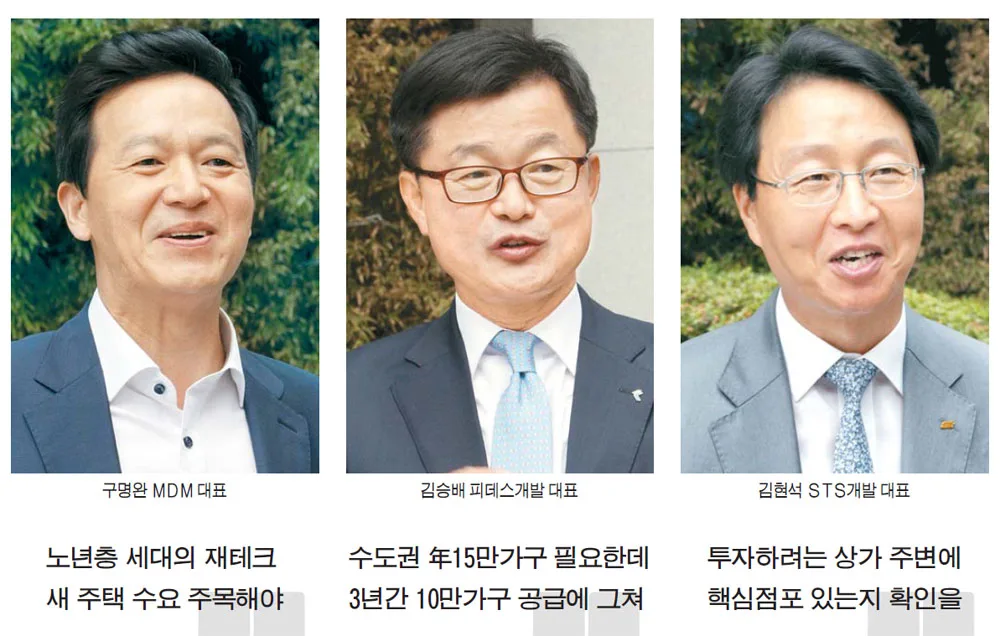
Even during the summer off-season, home transactions are increasing and prices are showing a gentle upward trend. Expectations are growing that transaction volume will pick up in earnest after Chuseok and that price increases will become more visible. Beyond housing, income-generating real estate such as small and mid-sized buildings, retail shops, and officetels is also stirring. How will Korea's real estate market unfold, and how should investors approach it? The work of developers is to identify promising land and add value to it. We introduce the market trends and outlook as seen by three leading figures in Korea's real estate development industry: Koo Myung-wan, CEO of MDM; Kim Seung-bae, CEO of Fides Development; and Kim Hyun-seok, CEO of STS Development. — With a recent flood of new pre-sales, talk of oversupply in the greater Seoul metropolitan area has already emerged. ▶ Koo Myung-wan: Pre-sale volumes are being carefully calibrated to meet buyer expectations. Looking further ahead, over the next few years there will be almost no private-sector site development apart from publicly developed land. Current pre-sale volumes are coming from sites that were prepared at least five years ago, and once this supply runs its course over the next one to two years, there will be no more "raw material" (developable sites), so new supply will decline and the metropolitan-area volume will naturally be absorbed. ▶ Kim Seung-bae: If we look at move-in volume as the real measure of supply, the greater Seoul area needs roughly 150,000–160,000 new apartment units every year, but supply over the past three years has averaged only around 100,000 units. As industries advance, people will continue to flow into Seoul and the metropolitan area. Buyer preferences are also changing, so new housing styles need to be supplied. In the metropolitan area, unsold apartments tend to sell out quickly once demand picks up. In the provinces, on the other hand, while the pre-sale market is currently hot, a great deal of that demand is investment-driven, and there are many cases of buyers pulling out before completion if conditions look unfavorable — so unsold units could remain an issue there. — If someone is buying a home, what kind of home should they buy? ▶ Koo Myung-wan: Real estate policy is still tied up in the National Assembly, but clear signals — such as the easing of loan regulations and interest rate cuts — have emerged, and expectations that other regulations will also be eased are spreading, causing the market to respond differently than before. Reconstruction projects have become less profitable due to burdens such as additional contribution charges, but in terms of future asset value and potential, they remain a blue chip investment above almost any other product. In particular, profitability is likely to improve if reconstruction regulations such as the excess profit reclamation charge, which has suppressed returns, are abolished. As the saying goes, "Gangnam is forever Gangnam" — demand there will persist no matter how much time passes. Presale rights in Wirye New Town, where resale restrictions have been lifted, already carry a premium but remain relatively affordable with room to rise further. Magok has drawn little attention so far as it lies on Seoul's outskirts, but it is worth watching given the large number of companies expected to move in. Pangyo and Gwanggyo are likely to become leading areas driving price increases in the metropolitan area going forward. — What are the current trends in income-generating real estate? ▶ Kim Hyun-seok: Retail is polarizing between simple roadside shops and concentrated mall-type developments. Investing in retail space can be split between direct investment based on assessed income value and indirect investment through REITs or funds — if you lack expertise in retail properties, the latter can be a good choice. With low interest rates persisting, housing has become less attractive as an investment. Commercial facilities, as an alternative asset class, are relatively undersupplied while offering strong business viability, so high returns can be expected for the time being. For direct investment, it's important to check whether a property has a key tenant, whether it benefits from foot traffic due to nearby parks or development areas like Yongsan, and to avoid judging based purely on inflated numbers about surrounding demand — instead verifying whether nearby retail sales and pre-sale prices are actually reasonable. For indirect investment, choose an asset manager that signs long-term contracts with creditworthy retail properties that have strong content competitiveness. ▶ Kim Seung-bae: As average life expectancy increases, people spend more time at home and consume more space. Research also shows that people are more active as investors after retirement than during their working years. This is driving investment in income-generating real estate such as officetels and retail space to generate income. The number of foreigners staying in Korea for several months at a time is also increasing, creating a need for new kinds of space. The current threshold for defining an aging population is 65 — it's worth reconsidering whether standards set in the past are still appropriate today. — What do you expect Seoul and the metropolitan area's future look and development trends to be? ▶ Koo Myung-wan: Seoul will be developed as a compact city. Bringing together diverse functions to increase efficiency is becoming increasingly important. Horizontal development was possible when there was plenty of idle land, but that approach has now reached its limits. The term "mega city" is also frequently mentioned — since future urban competitiveness will depend on maximizing efficiency with limited resources, high-density, concentrated development will become the trend. And whereas the focus until now has been on hardware such as building exteriors, the focus will shift toward software aspects such as interior content. We may well see ideal developments that let people feel nature amid the skyscrapers. ▶ Kim Hyun-seok: In Japan, urban regeneration efforts are combining residential, commercial, and office functions into high-density developments. Korea will essentially follow the same path. City centers will see high-density development capable of generating high added value, while commercial facilities that can be located farther out, where land is cheaper, will likely cluster around transit hubs as lower-value-added buildings — resulting in a mixed pattern. In fact, Korea is at a point where developments similar to Tokyo's Toranomon Hills should be getting underway, and there is a recognized need tied to urban regeneration, but regulatory barriers are preventing such projects from moving forward. With expensive financing costs and a structure that requires exiting within as short a period as possible, developers are not in a position to create profit value beyond mere use value. ■ Developing the KEPCO site in Samseong-dong could create a "second Gangnam Station" — Like Sinsa-dong's Garosu-gil or Itaewon's Gyeongnidan-gil, which commercial districts are worth watching going forward? ▶ Koo Myung-wan: Commercial districts broadly fall into two categories: those built around a key tenant to drive foot traffic, and those built on cultural identity. For example, Pangyo Alpha Dom is developing around a key tenant (anchor), while Hongdae is a district with no ups and downs thanks to a constant inflow of youth culture. Samseong-dong also has the potential to develop into a new commercial district as a "second Gangnam Station" if the KEPCO site is developed. Pangyo New Town's commercial district will also expand once Hyundai Department Store opens and the Seongnam–Yeoju double-track railway is completed. ▶ Kim Seung-bae: Areas where population concentrates or that sit along transportation corridors can become powerful commercial districts. Subway Line 9's "Golden Line" is a prime example. Suseo Station, where the KTX will open; the Uman-dong area, where Samsung's R&D center is moving in; and the Gwacheon area, where new public corporations are relocating, are all likely to develop commercial districts as population concentrates there. Gwacheon's commercial district took a temporary hit when central administrative agencies relocated to Sejong City, but it can recover once the population is replenished. — Buying small and mid-sized buildings has become a boom among wealthy investors. Is it worth investing when yields are below 4%? ▶ Koo Myung-wan: Rather than fixating on the current rental yield, it's better to invest when the answer to the question "Would remodeling improve the yield?" is a positive one. ▶ Kim Hyun-seok: The building market is also polarizing. The trend is shifting away from investments aimed at capital gains, as in the past, toward wealth management strategies focused on stable rental income. Buildings in mediocre locations and of mediocre size are more likely to see their asset value decline. ▶ Kim Seung-bae: In other countries, when building rents fall and yields decline, there are cases of converting properties to residential use. In Japan, for example, many small and mid-sized buildings have poor yields due to economic stagnation, leading to frequent conversions into residential space. [Reporters Lee Geun-woo / Lim Young-shin]